
3 Steps of a Habit
To start or stop a habit, it’s important to understand first how habits work. Many people incorrectly think that willpower plays a large role in habit formation. Research has demonstrated that willpower can support people in the “honeymoon” phase of habit development, but for old patterns to stop and new patterns to emerge, more than willpower is required.
The author Charles Duhigg, in his best-selling book, The Power of Habit, calls the process of habit the “Habit Loop,” referring to the cue, the routine, and the reward. The author and entrepreneur, James Clear, refers to these three phases as the Three R’s: Reminder, Routine, and Reward.
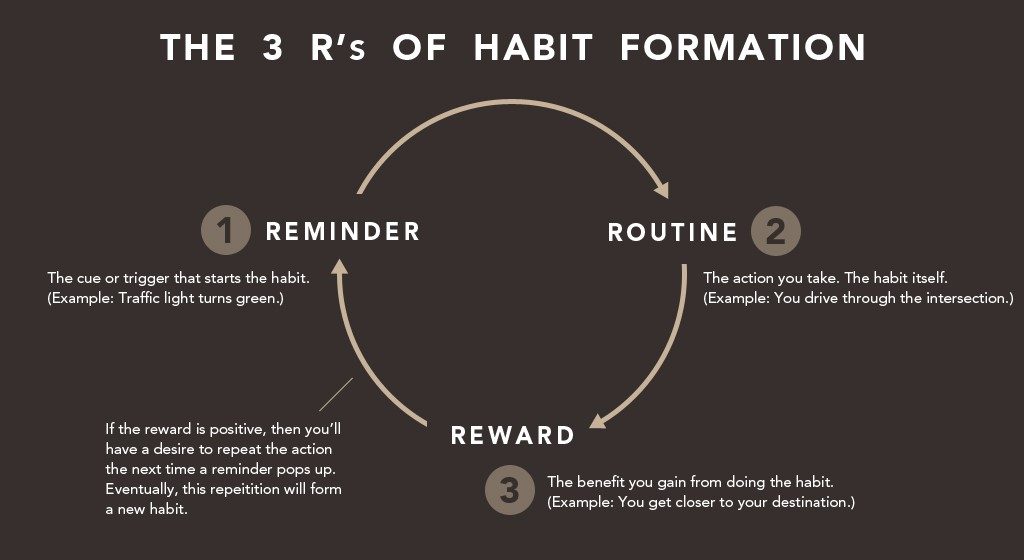
There are other ways out there to refer to this process, and all of them essentially outline the same ideas:
- There is some catalyzing event to trigger the habit. For example, if it’s smoking a cigarette, it could be sitting down with a cup of coffee. The cup of coffee would be the “triggering event”.
- Then there is the behavior. This is the activation of the habit. In this case it would be lighting up a cigarette.
- Ultimately there’s the perceived benefit. With this example, it would be a sense of relaxation as the nicotine enters the body.
Watch this 3 ½ minute video which illustrates Charles Duhigg’s three phase process of habits. Pay special attention to his point about focusing on maintaining the “Cue” and the “Reward” in your life, but focusing your energy on shifting the routine, or the habit. This, more than willpower, is where habits change and new patterns emerge.